
How to Choose Fence Styles for Commercial Properties
Choosing the right fence for a commercial property is about more than drawing a boundary. The ideal solution blends curb appeal with rock-solid protection, supports brand identity, and keeps your operations moving efficiently. In this guide, we’ll walk through the most effective commercial fence styles, compare leading business fencing options, and highlight how to design security fences that meet code, stand up to your climate, and fit your budget—without sacrificing style.
Start With Your Goals and Risks
Every successful fence project begins with clarity. Before you look at materials or colors, define what the fence must accomplish:
- Security level: Deter casual trespassers, stop theft, protect high-value assets, or meet critical infrastructure standards.
- Privacy needs: Hide inventory, screening for dumpsters or equipment, or maintain an open, welcoming appearance.
- Access and flow: Separate public vs. employee areas, manage deliveries, or create secure zones within a campus.
- Brand and aesthetics: Complement architecture, match corporate colors, or create a premium first impression.
- Compliance: Zoning setbacks, height limits, sight triangles, life-safety egress, ADA access, and industry-specific rules.
Map your perimeter and classify zones (public frontage, employee entries, loading docks, equipment yards). This “layered” approach—often called CPTED (Crime Prevention Through Environmental Design)—lets you combine commercial fence styles strategically rather than relying on a one-size-fits-all solution.
Understand the Most Common Commercial Fence Styles
Modern business fencing options span from sleek architectural designs to heavy-duty security fences. Here’s how the major categories compare:
Chain Link (Galvanized or Vinyl-Coated)
Best for: Industrial yards, utilities, logistics, sports fields.
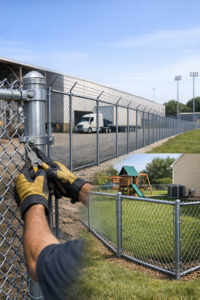
Chain link is the workhorse of commercial perimeters—affordable, durable, and fast to install. Specify heavy-gauge fabric, Schedule 40 posts, and galvanization inside and out for longevity. Add privacy slats or wind screens where needed, and consider barbed wire or razor ribbon (where legal) for higher security. For a cleaner look, vinyl-coated mesh in black or green blends into landscaping.
Ornamental Steel and Aluminum
Best for: Offices, retail frontages, hospitality, multi-tenant campuses.
Ornamental panels deliver upscale aesthetics with solid security. Steel offers rigidity and strength; aluminum resists corrosion, especially in coastal areas. Choose picket spacing for anti-climb performance and spear tops for deterrence. Powder-coated finishes provide long-lasting color and minimal maintenance—perfect when appearance is a priority.
Welded Wire and Anti-Climb Mesh
Best for: Data centers, utilities, distribution hubs, schools.
Welded wire panels, including tight 358 “prison mesh,” provide excellent anti-climb and anti-cut resistance with a modern, clean look. They’re a strong middle ground between ornamental and heavy industrial security fences.
Vinyl (PVC) and Composite Systems
Best for: Healthcare, multifamily, service yards, restaurants.
Vinyl and composite panels excel at privacy and low maintenance. They won’t rust or rot and are ideal for screening equipment or creating calmer environments. Reinforced posts and proper footings are critical for wind resistance, especially when continuous privacy panels catch gusts.
Wood (Select Commercial Applications)
Best for: Boutique retail, hospitality patios, historic districts.
While not the first choice for high-security applications, commercial-grade wood (with steel post systems and commercial fasteners) can deliver warm aesthetics for public-facing areas. Plan for ongoing maintenance and ensure finish and lumber are suitable for climate.
Masonry, Concrete, and Gabion Walls
Best for: High-security perimeters, noise reduction, luxury properties.
Block, brick, precast concrete, and gabion walls offer superior privacy, noise control, and impact resistance. They pair well with steel gates and controlled entry systems. Note that structural engineering, drainage, and permitting are often more complex.
Crash-Rated and Vehicle Mitigation Barriers
Best for: Critical infrastructure, storefront protection, high-risk sites.
When vehicle ramming is a concern, look for barriers and fences tested to ASTM F2656 crash standards (often called M or K ratings). Integrate bollards, deep foundations, or rated fence systems to prevent forced entry by vehicles.
Temporary and Modular Fencing
Best for: Construction sites, events, rapid deployment.
Freestanding panels with sandbags or anchors secure sites short-term. For longer projects, anchored posts with chain link or welded wire panels improve stability and security.
Match Commercial Fence Styles to Your Property Type
Use these quick pairings to narrow your business fencing options by use case:
- Retail and offices: Ornamental aluminum/steel at the street for curb appeal; welded wire or chain link with privacy for service areas.
- Industrial and warehouses: 8–10 ft galvanized chain link with anti-climb enhancements; crash-rated barriers at vulnerable approaches.
- Healthcare and education: Privacy vinyl/composite near patient or student areas; ornamental or welded wire along public edges; secure egress-compliant gates.
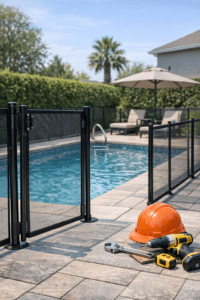
- Hospitality and multifamily: Decorative ornamental or horizontal-slat systems; pool code-compliant enclosures; acoustic panels near neighbors.
- Utilities and data centers: Anti-climb welded wire mesh with perimeter intrusion detection; security fences integrated with access control and surveillance.
- Auto dealers and outdoor retail: Tall chain link with privacy/wind screens for back lots; ornamental frontage with branded accents.
Design for Security First
At most commercial sites, the fence is part of a broader security ecosystem:
- Height and climb resistance: 7–10 ft is common for secure perimeters. Tight picket spacing, vertical profiles, and anti-climb mesh reduce footholds.
- Top treatments: Consider spear tops, curved outriggers, or barbed/razor enhancements where allowed by code.
- Gate security: The gate is the weakest link. Use heavy frames, tamper-resistant hardware, shielded hinges, and protected padlocks or electronic strikes.
- Access control: Card readers, keypads, intercoms, and vehicle detection tie into sliding or cantilever gate operators. Ensure UL 325 and ASTM F2200 compliance for automated gates.
- Lighting and visibility: Illuminate approaches and keep clear sightlines to cameras and guard posts.
- Layering: Consider inner compound fencing around especially sensitive assets for redundancy.
Balance Curb Appeal and Branding
Security doesn’t have to look harsh. Many commercial fence styles can elevate your site’s image:
- Color and finish: Powder-coated black or bronze complements most facades; custom RAL colors can